You already know foggy headlights look bad. What most drivers don’t realize is how much light they’re actually losing.
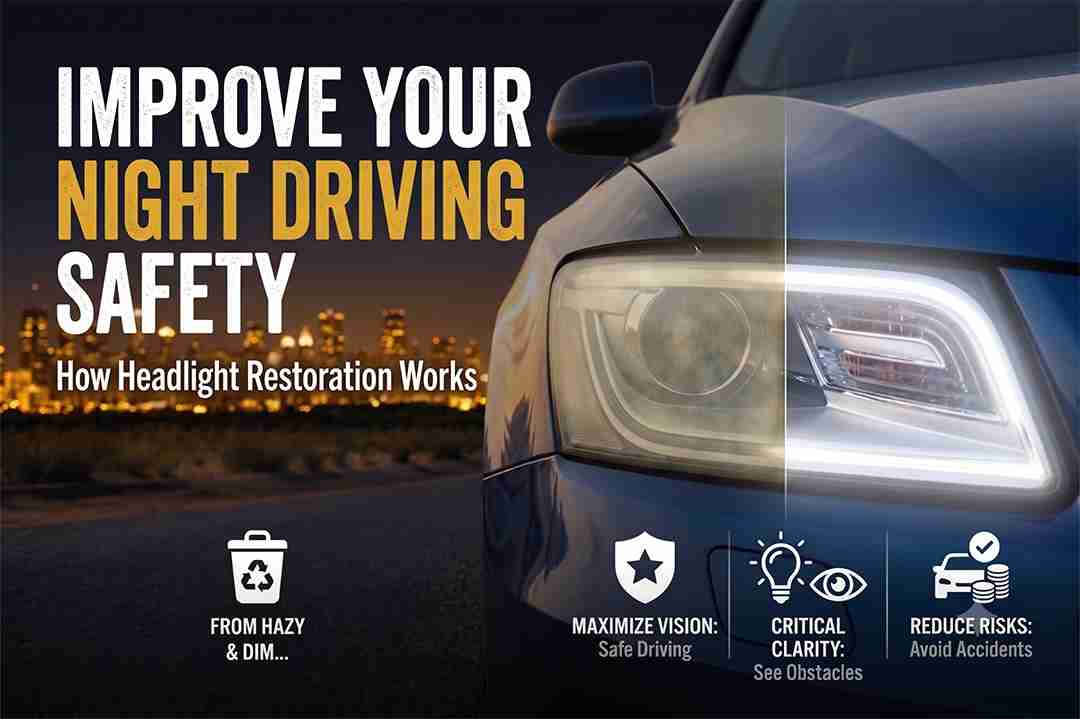
We’re not talking about a minor dip in brightness. AAA tested headlights that had clouded and yellowed with age and found they were putting out only about 20-22% of the light a new headlight produces. That’s roughly an 80% drop. Same bulb, same wiring, same car. The only difference is a hazy lens standing between your headlight and the road.
That’s not a cosmetic problem. It’s a visibility problem, and visibility is the whole job of a headlight.
Where All That Light Actually Goes
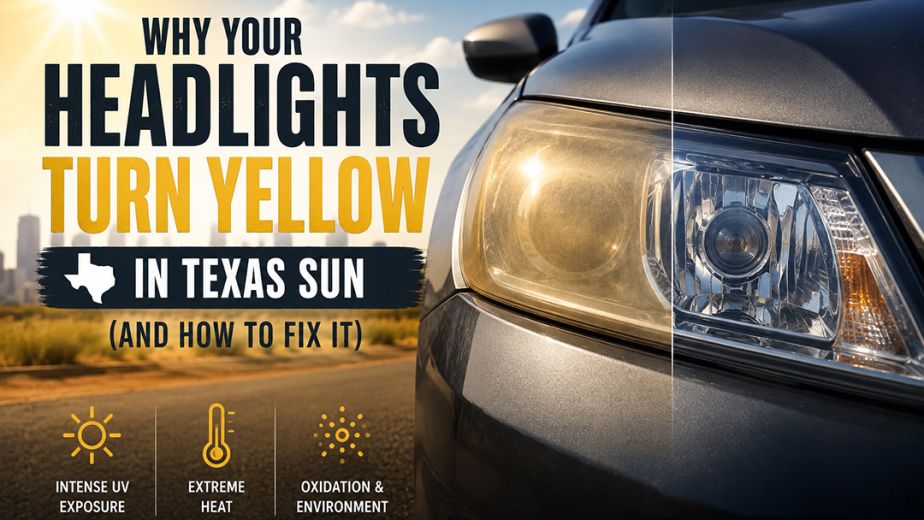
Headlight lenses are made from polycarbonate plastic with a clear UV-resistant coating baked on at the factory. North Texas sun is relentless, and that coating breaks down faster than most drivers expect, sometimes in as little as three to five years. Once the coating fails, the plastic underneath oxidizes. It turns yellow, then hazy, then cloudy. Every layer of that haze scatters and absorbs light instead of letting it pass through in a clean, focused beam.
The result is a beam pattern that’s dimmer, shorter, and less precise than it was designed to be. Instead of a crisp cutoff line lighting up the road ahead, you get a soft, scattered glow that doesn’t reach nearly as far. On a dark FM road outside Flower Mound with no streetlights, that shortfall is the difference between spotting a deer or a stalled car in time to react, and not.
This matters more than most people assume, even with healthy headlights. Roughly half of all traffic fatalities happen at night, despite a fraction of total driving happening after dark. Research from the Insurance Institute for Highway Safety has also found that vehicles with higher-rated headlight performance are involved in meaningfully fewer nighttime crashes, fewer driver-injury crashes, and fewer pedestrian crashes than vehicles with poor-rated headlights. Clarity isn’t a nice-to-have. It’s one of the more direct safety upgrades you can make to a car you already own.
The Texas Inspection Situation Has Changed (And Not in Your Favor)
Here’s something worth knowing if you’re driving around North Texas: as of January 1, 2025, Texas no longer requires an annual safety inspection for non-commercial vehicles. Drivers in DFW counties still handle an emissions test, but the old checklist that used to flag things like cloudy or dim headlights is gone.
That doesn’t mean the law changed. The Texas Transportation Code still requires two working white headlights, used from 30 minutes after sunset to 30 minutes before sunrise (or anytime visibility drops below 1,000 feet). Impaired or ineffective headlights are still a violation an officer can pull you over for. The difference is that nobody is routinely checking for you anymore. It’s fully on the driver to notice a cloudy lens before it becomes a ticket, a near miss, or worse.
In a lot of ways, that raises the stakes rather than lowering them. Fewer built-in checkpoints mean more headlights on North Texas roads quietly losing performance year after year, with no inspection sticker to force the issue.
What Restoration Actually Fixes
Headlight restoration doesn’t touch the bulb or the wiring. It goes after the lens itself, sanding down the oxidized, UV-damaged layer of plastic and polishing the surface back to true optical clarity, then sealing it with a fresh protective coating. Done right, it restores both the look of the headlight and the beam pattern and brightness the engineers originally designed it to produce.
That’s a very different outcome from a quick wipe-down or a bottle of polish from the parts store. Surface cleaners can knock some of the yellow tint off, but they don’t restore the beam pattern the way a full sanding and polishing process does, and they don’t come with real protection against the haze creeping right back in a few months later.
Replacing the whole headlight assembly will also get you back to full brightness, but on most trucks, SUVs, and sedans, that’s a few hundred dollars a side for a fix that professional-grade restoration handles for a fraction of the cost, done right in your driveway.
What I Can (and Can't) Bring Back to Life
Most of what I see in North Texas responds really well to restoration: F-150s, Silverados, Rams, Tahoes, and Suburbans with sun-baked lenses; everyday Camrys, Corollas, Civics, Accords, Altimas, and Hyundai/Kia models; and crossovers and minivans like the RAV4, CR-V, Odyssey, Pilot, and Outback. If your headlights have gone yellow or hazy on the outside, that’s usually exactly what this process is built to fix.
Some lenses have damage that’s happening inside the housing rather than on the surface, and sanding the outside of the lens won’t touch that. Cracks, internal haze, moisture trapped inside the lens, delamination, or burned-out projector bulbs fall into that category, and certain vehicles are more prone to it than others (some BMW, Audi, older Mercedes Xenon, Acura TL, and Nissan Altima models in particular). I’ll always tell you straight if your headlights are a restoration job or a replacement job. No point pretending otherwise.
Drive Like You Can Actually See
DFW traffic doesn’t slow down after dark. Between highway merges, unlit farm roads on the edges of North Texas, and everyone else’s headlights coming at you, you need every bit of visibility your car was built to give you, not 20% of it.
If it’s been a few years since your headlights looked genuinely clear, it’s worth a look. I will come to you, and most restorations wrap up in under an hour, right in your driveway or work parking lot. Schedule today.
Because yellow belongs on bananas. Not headlights.